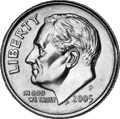
Features of this Coin Tosser
- Toss a coin
- Uses American dime for the toss
- Also allows side landing according to the probability of 1 in 6000
- Start and Stop the coin at your own will
Statistics of this Coin Flipper
-
Flip 45 Coins
Total Possible Combinations 46
Number of combinations are calculated using the formula
[ (2+45-1) choose (45) ] or [ 46 choose 45 ]
where 2 is the number of sides of the coin and 45 is the number of coins.
You can try generating all the combinations of Heads and Tails using the following combination generator
All possible combinations of 45 coins -
Flip 45 Coins
Total Possible Permutations 35,184,372,088,832
(around 35 trillion)
Number of permutations are calculated using the formula [ 2^45 ]
where 2 is the number of sides of the coin and 45 is the number of coins.
You can try generating all the permutations of Heads and Tails using the following permutations generator
All possible permutations of 45 coins
Probabilities of this 45 Coin Tosser
Assuming that all the coins are fair coins and probability of getting either Heads or Tails is 1/2 or 50%Probability of getting a Heads when flipping a coin 45 times
In technical terms, this is equivalent of getting atleast one Heads.
Probability of getting atleast one Heads is close to 1., about 100% percent.
The probability of getting atleast one Heads is calculated by multiplying all the probabilities of not getting a Heads for each coin and then subtracting the answer from 1.
P(Heads>=1)
            = 1 - [ P(H=0)Coin1 x P(H=0)Coin2 x P(H=0)Coin3 x P(H=0)Coin4 x P(H=0)Coin5 x P(H=0)Coin6 x P(H=0)Coin7 x P(H=0)Coin8 x P(H=0)Coin9 x P(H=0)Coin10 x P(H=0)Coin11 x P(H=0)Coin12 x P(H=0)Coin13 x P(H=0)Coin14 x P(H=0)Coin15 x P(H=0)Coin16 x P(H=0)Coin17 x P(H=0)Coin18 x P(H=0)Coin19 x P(H=0)Coin20 x ... ]
            = 1 - [ 1/2 x 1/2 x 1/2 x 1/2 x 1/2 x 1/2 x 1/2 x 1/2 x 1/2 x 1/2 x 1/2 x 1/2 x 1/2 x 1/2 x 1/2 x 1/2 x 1/2 x 1/2 x 1/2 x 1/2 x ... ]
You can generate all possible permutations and combinations of 45 Coins containing atleast one Heads using the following permutations and combinations generator
All possible combinations of 45 coins with atleast one Heads
All possible permutations of 45 coins with atleast one Heads
To verify the answer, you can divide the number of permutations containing atleast 1 Heads by number of total possible permutations of 45 coins.
Probability of not getting a Heads when flipping 45 Coins
Probability of not getting any Heads is close to 0.0000000000000284, about 0.0000000000028% percent.
Probability of getting zero Heads is calculated by multiplying all the probabilities of not getting a Heads for each coin.
P(Heads=0)
            = P(H=0)Coin1 x P(H=0)Coin2 x P(H=0)Coin3 x P(H=0)Coin4 x P(H=0)Coin5 x P(H=0)Coin6 x P(H=0)Coin7 x P(H=0)Coin8 x P(H=0)Coin9 x P(H=0)Coin10 x P(H=0)Coin11 x P(H=0)Coin12 x P(H=0)Coin13 x P(H=0)Coin14 x P(H=0)Coin15 x P(H=0)Coin16 x P(H=0)Coin17 x P(H=0)Coin18 x P(H=0)Coin19 x P(H=0)Coin20 x ...
            = 1/2 x 1/2 x 1/2 x 1/2 x 1/2 x 1/2 x 1/2 x 1/2 x 1/2 x 1/2 x 1/2 x 1/2 x 1/2 x 1/2 x 1/2 x 1/2 x 1/2 x 1/2 x 1/2 x 1/2 x ...
Probability of getting exactly 1 Heads or 44 Tails when flipping 45 Coins
Probability of getting exactly 1 Heads is close to 0.00000000000128, about 0.00000000013% percent.
You can calculate this using counting or by using the binomial distribution
Using Counting
You can think of 45 coins as spots to be filled. There are 35,184,372,088,832 ways to fill these spots with either a Heads or Tails (all possible permutations). Now, we need to find how many of these permutations contain exactly 1 Heads. In other words, in how many different ways can we place 1 Heads in 45 spots? Or, in how many ways can we pick 1 out of 45 spots? The answer can be caclulated using the formula [ 45 choose 1 ]. So, there are 45 ways to choose 1 out of 45 spots. The probability is calculated by dividing the number of ways to pick 1 spots by the number of total permuations.
P (H=1)
                = Ways to pick 1 out of 45 spots / Total permutations of 45 coins
                = (45 choose 1) / (2^45)
                = 45 / 35184372088832
Using Binomial Distribution
In Binomial Distribution, we look for k number of successful events in n number of trials where p is the probability of each successful event. Here, a successful event means getting a Heads and an event means a coin flip.
To get exactly 1 Heads, we need k=1 successful events out of total n=45 events. Each event has a probability p=1/2 of occuring.
Probability of k=1 successful events is then calculated as follows.P(k=1)
= (n choose k) pk (1-p)n-k
= (45 choose 1) (1/2)1 (1/2)45-1
= (45 choose 1) (1/2)45
= 45 x (1/35184372088832)
You can generate all possible permutations and combinations of 45 Coins containing exactly 1 Heads using the following permutations and combinations generator All possible combinations of 45 coins with exactly 1 Heads All possible permutations of 45 coins with exactly 1 Heads
To verify the answer, you can divide the number of permutations containing exactly 1 Heads by number of total possible permutations.
Probability of getting exactly 23 Heads or 22 Tails when flipping 45 Coins
Probability of getting exactly 23 Heads is close to 0.117, about 11.7% percent.
You can calculate this using counting or by using the binomial distribution
Using Counting
You can think of 45 coins as spots to be filled. There are 35,184,372,088,832 ways to fill these spots with either a Heads or Tails (all possible permutations). Now, we need to find how many of these permutations contain exactly 23 Heads. In other words, in how many different ways can we place 23 Heads in 45 spots? Or, in how many ways can we pick 23 out of 45 spots? The answer can be caclulated using the formula [ 45 choose 23 ]. So, there are 4116715363800 ways to choose 23 out of 45 spots. The probability is calculated by dividing the number of ways to pick 23 spots by the number of total permuations.
P (H=23)
                = Ways to pick 23 out of 45 spots / Total permutations of 45 coins
                = (45 choose 23) / (2^45)
                = 4116715363800 / 35184372088832
Using Binomial Distribution
In Binomial Distribution, we look for k number of successful events in n number of trials where p is the probability of each successful event. Here, a successful event means getting a Heads and an event means a coin flip.
To get exactly 23 Heads, we need k=23 successful events out of total n=45 events. Each event has a probability p=1/2 of occuring.
Probability of k=23 successful events is then calculated as follows.P(k=23)
= (n choose k) pk (1-p)n-k
= (45 choose 23) (1/2)23 (1/2)45-23
= (45 choose 23) (1/2)45
= 4116715363800 x (1/35184372088832)
You can generate all possible permutations and combinations of 45 Coins containing exactly 23 Heads using the following permutations and combinations generator All possible combinations of 45 coins with exactly 23 Heads All possible permutations of 45 coins with exactly 23 Heads
To verify the answer, you can divide the number of permutations containing exactly 23 Heads by number of total possible permutations.
Probability of getting exactly 44 Heads or 1 Tails when flipping 45 Coins
Probability of getting exactly 44 Heads is close to 0.00000000000128, about 0.00000000013% percent.
You can calculate this using counting or by using the binomial distribution
Using Counting
You can think of 45 coins as spots to be filled. There are 35,184,372,088,832 ways to fill these spots with either a Heads or Tails (all possible permutations). Now, we need to find how many of these permutations contain exactly 44 Heads. In other words, in how many different ways can we place 44 Heads in 45 spots? Or, in how many ways can we pick 44 out of 45 spots? The answer can be caclulated using the formula [ 45 choose 44 ]. So, there are 45 ways to choose 44 out of 45 spots. The probability is calculated by dividing the number of ways to pick 44 spots by the number of total permuations.
P (H=44)
                = Ways to pick 44 out of 45 spots / Total permutations of 45 coins
                = (45 choose 44) / (2^45)
                = 45 / 35184372088832
Using Binomial Distribution
In Binomial Distribution, we look for k number of successful events in n number of trials where p is the probability of each successful event. Here, a successful event means getting a Heads and an event means a coin flip.
To get exactly 44 Heads, we need k=44 successful events out of total n=45 events. Each event has a probability p=1/2 of occuring.
Probability of k=44 successful events is then calculated as follows.P(k=44)
= (n choose k) pk (1-p)n-k
= (45 choose 44) (1/2)44 (1/2)45-44
= (45 choose 44) (1/2)45
= 45 x (1/35184372088832)
You can generate all possible permutations and combinations of 45 Coins containing exactly 44 Heads using the following permutations and combinations generator All possible combinations of 45 coins with exactly 44 Heads All possible permutations of 45 coins with exactly 44 Heads
To verify the answer, you can divide the number of permutations containing exactly 44 Heads by number of total possible permutations.
Probability of getting all Heads when flipping 45 Coins
Probability of getting all Heads is close to 0.0000000000000284, about 0.0000000000028% percent.
This is calculated by multiplying together all the probabilities of getting a Heads for each coin.
P(Heads=45)
            = P(H=1)Coin1 x P(H=1)Coin2 x P(H=1)Coin3 x P(H=1)Coin4 x P(H=1)Coin5 x P(H=1)Coin6 x P(H=1)Coin7 x P(H=1)Coin8 x P(H=1)Coin9 x P(H=1)Coin10 x P(H=1)Coin11 x P(H=1)Coin12 x P(H=1)Coin13 x P(H=1)Coin14 x P(H=1)Coin15 x P(H=1)Coin16 x P(H=1)Coin17 x P(H=1)Coin18 x P(H=1)Coin19 x P(H=1)Coin20 x ...
            = 1/2 x 1/2 x 1/2 x 1/2 x 1/2 x 1/2 x 1/2 x 1/2 x 1/2 x 1/2 x 1/2 x 1/2 x 1/2 x 1/2 x 1/2 x 1/2 x 1/2 x 1/2 x 1/2 x 1/2 x ...
Probability of getting one of a kind when flipping 45 Coins
Probability of getting one of a kind is close to 0.0000000000000568, about 0.0000000000057% percent.
There are 2 ways to get one of a kind (all Heads or all Tails). The probability of getting all of any kind is then caclulated by adding the probability of getting all Heads or all Tails. Since, probabilities of getting all Heads or all Tails are the same, we can just multiply one of them by 2. So, multiplying the probability of getting all Heads by 2 will give us the probability of getting all of any kind.
    Probability of getting all of a kind
        = Pobability of getting all Heads + Pobability of getting all Tails
        = 2 x Pobability of getting all Heads
        = 2 x (1/2 x 1/2 x 1/2 x 1/2 x 1/2 x 1/2 x 1/2 x 1/2 x 1/2 x 1/2 x 1/2 x 1/2 x 1/2 x 1/2 x 1/2 x 1/2 x 1/2 x 1/2 x 1/2 x 1/2 x ...)
Javascript code to Flip 45 Coins
    // Flip 45 Coins


        // define the range of numbers to pick from
        var lowest = 1;             // lowest possible side of the coin // 1 for heads
        var highest = 2;           // highest possible side of the coin // 2 for tails
        var number_of_coins = 45;    // how many coins to flip

        // allow the coin to land on the side
        // change to false if sidelanding not desired
        var allow_sidelanding = true;

        var PROBABILITY_OF_SIDELANDING = 6000; // set the probability of sidelanding to 1 in 6000

        var this_flip = []; // array to store the results of this flip

        for (var j = 1; j <= number_of_coins; j++) {

            // loop for the number of coins

            // for each coin, generate a number between lowest and highest i.e. 1 or 2
            var coin_face = Math.floor(Math.random() * (highest-lowest+1) + lowest);

            // if sidelanding is allowed
            if (allow_sidelanding) {

                // first check for sidelanding scenario with given probability
                var edge = Math.floor(Math.random() * (PROBABILITY_OF_SIDELANDING-1+1) + 1);

                // if sidelanding is probable, override the coin face with edge value i.e. 3
                // i.e. if we generated a 1 when generating a number between 1 and PROBABILITY_OF_SIDELANDING
                if (edge === 1) {
                    coin_face = 3;
                }

            }


            this_flip.push(coin_face); //store this in the array
        }


        // print all the generated flips

        for (j = 0; j < this_flip.length; j++) {

            // loop through the coin array

            //print each coin flip value followed by a space
            document.write(this_flip[j]);
            document.write(" ");

        }


    /*

    Sample output


    */